Removal, trimming, storm cleanup, and stump grinding across New Bern and Craven County. Written estimates before the work starts.
Call (555) 555-5555Or call — we answer. No obligation, honest advice.
Where the Neuse meets the Trent, trees live under conditions the rest of the state does not share. Salt carries inland on the wind and burns the windward side of anything exposed, which is why pines near open water often look combed in one direction. The water table sits close enough to the surface that roots spread wide and shallow instead of driving down. And every few years a storm arrives off the Atlantic to test the result.
Craven County's canopy divides roughly into three. The historic blocks carry live oaks that were mature before most of the surrounding streets existed, and those trees are part of why the district looks the way it does. Everything built since about 1970 - Trent Woods, River Bend, out toward Fairfield Harbour - is ringed with loblolly pines that grew fast and tall. And the riverfront lots along both rivers hold hardwoods that take the first of every blow. Each of those groups asks for different judgment.
September 2018 is the reference point everyone here uses. Florence sat over the two rivers, put centuries-old oaks down across historic district streets and pines through roofs across the subdivisions, and left a cleanup that ran for months. It also drew in a wave of operators who were gone by spring. Both halves of that are worth remembering.
The approach here is plain. Look at the tree, say honestly what it needs, put the estimate in writing, and turn up when we said we would. Removal quotes include cleanup and haul-off. When a tree is sound and the answer is to leave it alone, that is what you will be told.
Around New Bern the thing under the tree is frequently older than the state. Working above a two-hundred-year-old roof means every piece comes down on a rope in a planned order, at a speed somebody controls, because there is no version of that structure that gets replaced if something goes wrong.
The same discipline applies on a suburban lot with a fence and a pool - it just costs less to get wrong. Sites get raked before we leave, and on soft riverfront ground the equipment route matters as much as the cutting plan.

Removal, trimming, and stump grinding cover most of what a Craven County property needs, with storm response for when the Atlantic has other plans.
Storm-damaged, dead, and hazardous trees taken down safely, including rigged removals over historic structures and tight waterfront lots. Cleanup and haul-off included.
Deadwood, roof and drive clearance, and careful reduction on heritage live oaks. Cuts placed at the branch collar so the wound can close.
Stumps taken below grade so the ground can be replanted, sodded, or simply mowed across.
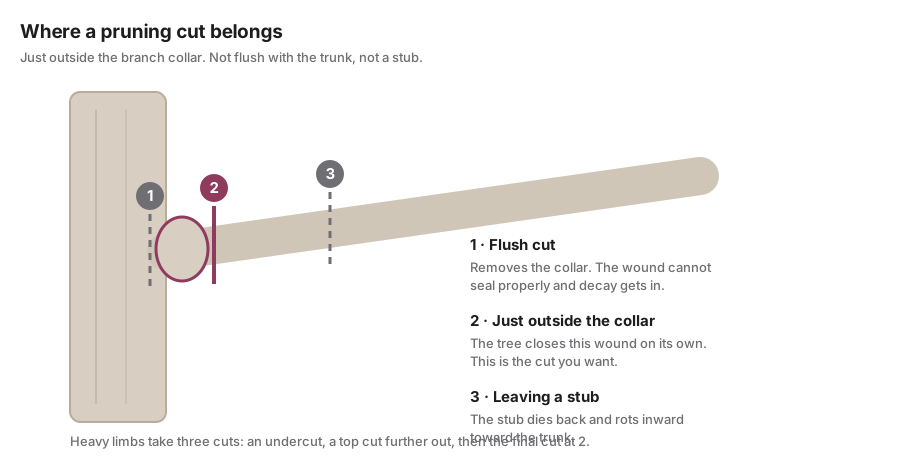
On a live oak that has been standing since the eighteenth century, a bad cut is not a cosmetic problem - it is a wound the tree may spend the rest of its life failing to close. The detail that decides it is small: at the base of every limb sits a slightly raised ring, the branch collar, holding the tissue the tree uses to seal itself. A cut placed immediately outside that ring heals. One placed through it does not.
Removing the collar along with the branch takes away the mechanism, and decay moves into the trunk over the following years. Leaving a projecting stub produces the same outcome by a different route - the stub dies, then rots back toward the trunk. Neither error is visible the week it happens, which is exactly why bad pruning is so common and so rarely traced back to whoever did it.
Anything of real weight comes off in three stages: an undercut, a relief cut further out to shed the load, then the finishing cut at the collar. One pass through a heavy limb and the limb tears away before the saw finishes, stripping a long ribbon of bark down the trunk as it falls.
Salt is the first difference. Onshore wind carries it further inland than most people expect, and it burns foliage on the exposed side of a tree, which is why waterfront pines so often carry thin, one-sided crowns. That asymmetry is not only cosmetic - a crown weighted unevenly loads the trunk unevenly when a real wind arrives.
The water table is the second. Where groundwater sits close to the surface, roots have no reason to go deep and every reason to run wide and shallow. That works perfectly well until the ground is saturated and a storm pushes sideways, at which point a shallow plate is exactly what it sounds like. It explains why so many trees here go over intact rather than snapping partway up.
Live oaks are the exception, and worth understanding on their own terms. Their shape - low, spreading, dense-wooded - is essentially a wind design, which is how the historic district still has them. They are also slow to replace in any meaningful sense: a live oak lost is not a gap that fills in a decade. That asymmetry between how long they take and how quickly they can be removed is the reason to get a second opinion before taking one down.
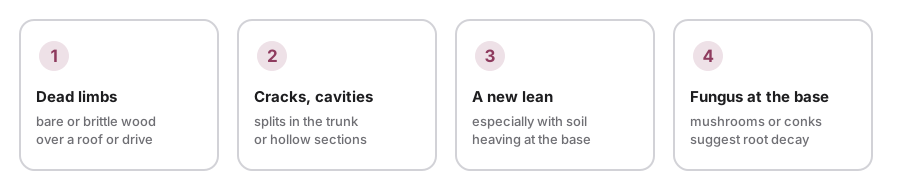
Loblolly pines behave the opposite way. Fast growth buys height and not much anchorage, and a stand that grew together tends to fail together once wind finds an opening. The warnings are ordinary and worth walking your property for: limbs that have been dead a while, cracks or cavities in the trunk, a lean that appeared recently, and mushrooms or shelf fungus near the base suggesting the roots are going.
None of these condemn a tree by itself. All of them are better examined in February than discovered in September.
The sequence is the same whether the job is one limb over a porch or a pine leaning at a roofline.
Someone looks at the actual tree and writes the number down, with cleanup and haul-off inside it rather than added at the end.
Over a historic roof or a waterfront deck, the sequence gets worked out before anything is cut, and pieces come down under control.
Chips cleared, debris hauled, ruts avoided on soft ground. When we go, the yard should look like the tree simply is not there anymore.
Tree work in New Bern's historic blocks comes with constraints that do not apply four streets away, and it is worth knowing about them before you need the work rather than during it.
The practical constraint is space. Narrow streets, close-set houses, and mature canopy mean there is often nowhere for a piece to fall and no room to bring a large machine in. That pushes the job toward climbing and rigging, which takes longer and costs more than dropping a tree in an open yard - and is the entire reason the roof underneath survives the day.
The other constraint is procedural. Historic districts commonly regulate what can be done to trees within them, and requirements vary by district and by street. Before removing a substantial tree in the district, check with the city whether approval is needed. Any company that tells you the paperwork does not matter is telling you something useful about how they work.
Heritage live oaks deserve a separate word. The reflex after a storm is to take down anything that looks damaged, and with these trees that reflex is frequently wrong. A live oak can lose significant limbs and recover fully over a decade. Before agreeing to remove one, get an honest assessment of what is actually structural versus what merely looks alarming - and if the first opinion is removal, get a second.
New Bern is the base, and the service area covers Craven County and its edges - Trent Woods, River Bend, James City, Bridgeton, Fairfield Harbour, and out toward Havelock, Vanceboro, Ernul, Cove City, and Dover. That range takes in the historic district's live oaks, the pine-ringed subdivisions, and the riverfront lots along both the Neuse and the Trent.
Travel time is part of the quote toward the outer edges, and we will say so on the phone rather than adding it to the invoice later. If you are just past the list below, it is still worth a call.

Hurricane season is a fixed feature of the calendar here, not a surprise, and that changes what sensible tree maintenance looks like. A canopy with its deadwood taken out has materially less to throw at a roof. A pine already leaning toward the house is a scheduled job in March and an emergency in September, at a very different price and a very different wait.
When a storm does come through, the order of work sorts itself quickly. Trees on houses, on vehicles, or blocking access come first. Anything in contact with a power line is a utility call before it is a tree call, and not something for a homeowner to approach at any distance. A large tree lying across an open lawn is the least urgent thing on the list however dramatic it looks.
The other thing that follows a storm here is a wave of out-of-area crews. Some are competent. The ones that knock on doors, want cash, and ask for money up front before any work are the reason this county has stories. Protect yourself the same way with anyone, including us: get the scope in writing first, do not pay a substantial deposit before work begins, and ask for a certificate of insurance sent to you directly by the insurer rather than handed over as a photocopy. Tree work carries enough risk that an uninsured crew on your property becomes your exposure.
Estimates are free and written. What drives a removal price is size, species, and access above all - a pine that can be felled whole in an open yard is a fundamentally different job from the same pine between a historic home and a fence, which is why a real number comes from looking rather than from a description over the phone. Trimming prices by scope; stump grinding by diameter and count.
Call (555) 555-5555 for removal, trimming, storm cleanup, or stump grinding anywhere in New Bern and Craven County. The cheapest time to deal with a tree you have been watching is the stretch of the year when nobody else is thinking about it.
Tell us what you need and we'll get back to you with a real answer. If it's an active backup or standing water over the field, calling gets you a faster response.
Call: (555) 555-5555
Area: New Bern, NC and Craven County